Solar adoption has moved past the “panels on a roof” stage. The real value today lives in how well a system stores and dispatches energy, not just how much it generates. Choosing the right storage architecture, and the right inverter to run it, matters just as much as panel count or wattage.
This guide helps homeowners, installers, and commercial and industrial buyers understand how residential energy storage systems, 50kW inverters, and hybrid or off-grid inverter platforms fit together, so you can choose lithium-ion battery storage that actually matches your load profile instead of over- or under-sizing your investment.
What Is a Residential ESS and Why It Matters
A residential energy storage system, or ESS, pairs a lithium-ion solar battery with an inverter and a controller that decides when to charge, discharge, or export power. Instead of solar energy flowing straight to the grid or being wasted at midday, it’s stored and used during evening peaks or outages instead. For homeowners, this translates into lower utility bills, backup power during outages, and in many regions, the ability to participate in demand-response or time-of-use arbitrage programs. A well-designed residential ESS is what turns a standard rooftop solar setup into a true 24-hour power solution.
The core components of a residential ESS work together as a system rather than in isolation. Lithium iron phosphate battery modules remain the dominant chemistry for solar storage thanks to their thermal stability and long cycle life. A hybrid inverter converts DC solar and battery power into AC while managing charge and discharge logic in real time. An energy management system is the software layer that optimizes when to store, use, or sell power based on rates and demand. A battery management system protects the cells from overcharge, overheating, and imbalance throughout the system’s lifespan.
Hybrid vs. Off-Grid Inverters: Core Differences
This is where many buyers get confused, so it’s worth being explicit about the distinction.
A hybrid inverter stays connected to the utility grid. It can pull from the grid, push excess solar back to it, and switch to battery power automatically during an outage. Most residential and light C&I installations use hybrid inverters because they offer real flexibility: you get backup power without giving up grid access entirely. This grid-tied flexibility is one of the biggest reasons a residential ESS remains the most popular choice for homeowners who still want a utility connection as a safety net.
An off-grid inverter, by contrast, is designed for sites with no utility connection at all, rural properties, remote telecom towers, agricultural operations, or backup microgrids. These inverters must manage 100% of the load themselves, which is why they’re typically paired with larger battery banks and, in many cases, a generator for redundancy.
For C&I energy storage, the calculus changes again. Commercial sites often need 50kW inverters or larger, three-phase capable, and built specifically for peak shaving, demand charge management, and sometimes frequency regulation, rather than backup power alone.
Comparing System Types at a Glance
| Feature | Residential Hybrid ESS | Off-Grid Inverter System | C&I Energy Storage (50kW+) |
| Typical power rating | 3–10 kW | 5–20 kW | 30–100+ kW |
| Grid connection | Grid-tied with backup | None (standalone) | Grid-tied, often three-phase |
| Battery chemistry | LFP (LiFePO4) | LFP or lead-acid hybrid | LFP, containerized |
| Primary use case | Bill savings + backup | Remote/rural power | Demand charge reduction, peak shaving |
| Typical battery capacity | 5–20 kWh | 10–40 kWh | 100 kWh–several MWh |
| Payback driver | Utility rate arbitrage | Avoided diesel/fuel cost | Demand charge + incentive stacking |
Sizing a Lithium Battery Storage System
Sizing mistakes are the most common reason ESS projects underperform, and a few practical rules go a long way toward avoiding them.
Match battery capacity to daily usage, not just panel output. A home using 25 kWh per day typically wants at least 10 to 15 kWh of usable storage to comfortably cover evening hours. Size the inverter to peak demand, not average load, since a 50kW inverter is appropriate wherever simultaneous loads like HVAC, machinery, and EV chargers can stack up quickly, which is common in C&I settings. Account for depth of discharge, since most lithium battery storage systems are rated for 90 to 100% usable DoD, unlike older lead-acid systems limited to roughly 50%. Finally, plan for round-trip efficiency losses, which typically run 85 to 95% for modern lithium-ion solar batteries and directly affect how much stored energy is actually usable.
Evaluating Manufacturers
When comparing an off-grid inverter manufacturer or a hybrid inverter manufacturer, it pays to look past the headline power rating and check a handful of specific factors.
Certifications are a baseline requirement, not a bonus feature. UL 1741 in the US, IEC 62109 internationally, and grid-interconnection compliance under IEEE 1547 are the minimum standards for safe grid-tied operation.
Warranty terms have become fairly standardized across reputable manufacturers, with battery warranties in the 6,000 to 10,000 cycle range, roughly 10 years, now considered typical for quality lithium-ion systems.
Parallel or stacking capability matters most for C&I energy storage specifically. Confirm the inverter can be stacked to reach the site’s full kW requirement without triggering a full re-engineering effort down the line.
Remote monitoring and EMS integration is critical for both residential and commercial operators, especially those managing multiple sites or properties from a single dashboard. For a residential ESS, this kind of remote visibility also makes it much easier to spot performance drops early, before they turn into a costly repair.
How the System Architecture Comes Together
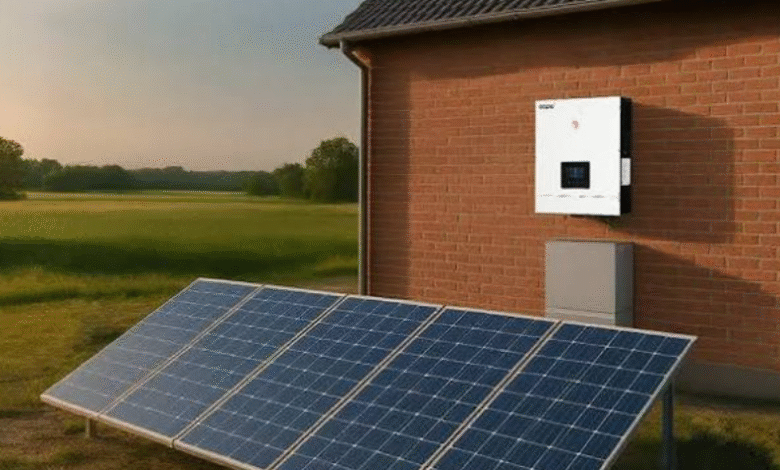
It helps to picture how energy actually flows through a typical hybrid residential or light C&I system. Solar panels feed DC power into the hybrid inverter, which manages conversion and directs energy either to the battery bank, the connected loads, or the utility grid depending on real-time conditions and rate structures. The energy management system oversees this decision-making, optimizing for cost savings or backup readiness based on the site’s specific goals. In an off-grid configuration, the grid connection is simply absent from this picture entirely, and the battery bank, along with a generator if one is present, has to cover 100% of load demand independently, with no fallback if something goes wrong.
Why Independent Technical Benchmarks Matter
Because inverter and battery manufacturers naturally emphasize their own products’ strongest figures, it’s worth grounding any comparison in independent storage technology benchmarks rather than relying solely on a single manufacturer’s data sheet. Independent storage technology benchmarks track real-world battery degradation, inverter efficiency under varied load conditions, and cost trends across the wider market, offering a much clearer picture than any one company’s marketing claims. Checking a shortlisted system’s specifications against independent storage technology benchmarks before finalizing a purchase is one of the simplest ways to catch an overly optimistic claim before it becomes an expensive surprise after installation.
See aso: Transforming Brand Narratives into Business Assets
Final Thoughts
Choosing between a residential hybrid ESS, an off-grid inverter system, and full-scale C&I energy storage comes down to matching the architecture to your actual load profile, grid access, and financial goals, not simply picking the biggest or most feature-rich option available. Getting battery capacity, inverter sizing, and manufacturer certifications right from the start is what separates a system that reliably delivers savings and backup power for over a decade from one that underperforms almost immediately. Take the time to size against real usage data and verify manufacturer claims independently, and the resulting system will match your needs far more closely than one chosen on price or headline specs alone.