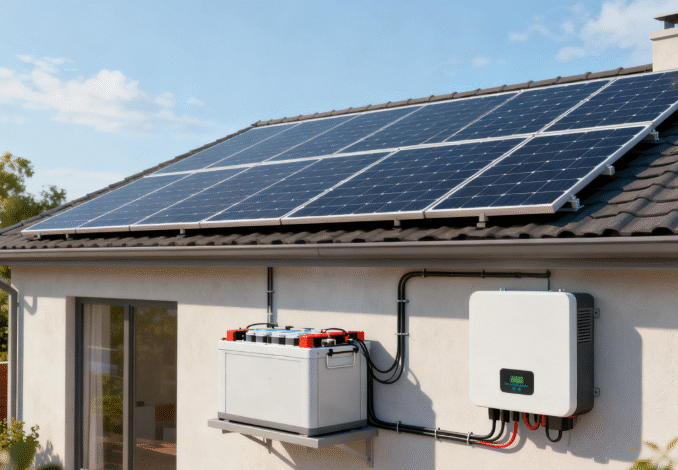
Installing solar panels only solves half the equation. Without the right solar energy storage solutions in place, excess power generated at midday either gets exported back to the grid at low value or wasted entirely, while you still pay peak rates in the evening when the sun goes down. Choosing the right storage solution is what actually determines whether a solar investment delivers real energy independence or just a smaller utility bill with the same old reliance on the grid.
This guide walks homeowners, businesses, and installers through the full landscape of solar energy storage solutions available today, how to compare them, and what to check before committing to a system, so you end up with storage that matches your actual usage patterns rather than a generic package sized for someone else’s home or facility.
Why Solar Energy Storage Solutions Matter
Solar panels generate power on their own schedule, driven by sunlight, not by when you actually need electricity. Without storage, that mismatch means either exporting surplus power to the grid, often at a lower rate than you pay to buy it back, or losing access to your own generation the moment the sun sets or a cloud passes overhead. Solar energy storage solutions close that gap by capturing excess generation and releasing it exactly when it’s needed, whether that’s during evening peak hours, a grid outage, or a period when utility rates spike.
Beyond simple bill savings, storage adds resilience. Homes and businesses with battery backup keep essential circuits running during outages, and in some markets, storage systems can even generate revenue by participating in demand response or grid services programs.
Core Components of a Solar Energy Storage Solution
A complete solar energy storage solution is built from several parts working together, not just a battery sitting in a garage.
Battery cells, most commonly lithium iron phosphate today, store the actual energy and are prized for their safety, thermal stability, and long cycle life compared to older chemistries.
A hybrid or off-grid inverter manages the conversion between DC solar and battery power and AC power used by your home or facility, along with the logic that decides when to charge or discharge.
A battery management system protects the cells from overcharge, over-discharge, and thermal issues at the individual cell level, which is what keeps a storage system safe over years of daily cycling.
Energy management software ties everything together, letting owners monitor performance remotely and, in many systems, automating charge and discharge decisions based on usage patterns and utility rate structures.
Types of Solar Energy Storage Solutions
All-in-One Residential Systems
These combine the battery, inverter, and management electronics into a single enclosure, simplifying installation for homeowners. They’re the most common choice for residential solar-plus-storage projects because they reduce the number of separate components an installer needs to source and wire.
Modular Stackable Systems
Modular systems let capacity be added incrementally as needs grow, making them a strong fit for households or small businesses that expect to expand their storage over time rather than committing to a fixed capacity upfront.
Commercial & Industrial (C&I) Storage
C&I-scale solar energy storage solutions are sized for demand charge management and peak shaving at commercial and industrial sites, typically ranging from tens of kW to several megawatts, with financial payback driven more by avoided demand charges than simple self-consumption.
Off-Grid Storage Systems
Designed for sites with no utility connection at all, off-grid solar energy storage solutions must cover 100% of a site’s power needs independently, which usually means larger battery banks and, frequently, a backup generator for extended low-sun periods.
Comparing Solar Energy Storage Solutions
| Solution Type | Typical Capacity | Best Fit | Primary Benefit |
| All-in-one residential | 5–15 kWh | Homeowners | Bill savings + backup power |
| Modular stackable | 10–60 kWh | Homes / light commercial | Flexible future expansion |
| C&I storage | 30 kW–several MW | Businesses, industrial sites | Demand charge reduction |
| Off-grid systems | 10–40 kWh+ | Remote or rural properties | Full energy independence |
What to Look For Before Choosing a Storage Solution
Usable capacity versus rated capacity should always be confirmed directly, since the depth of discharge a system safely supports determines how much of its rated capacity you can actually use day to day.
Round-trip efficiency affects how much of your stored solar energy is actually usable after a full charge and discharge cycle, with modern lithium-ion systems typically retaining 85 to 95% of stored energy.
Cycle life and warranty terms matter more than upfront price alone. Look for warranties specified in both years and cycles, along with a guaranteed minimum capacity retention at the end of that warranty period.
Certifications are non-negotiable for safety. Any solar energy storage solution should meet recognized safety and grid-interconnection standards relevant to your region before installation.
Scalability is worth confirming upfront, particularly whether additional capacity can be added later without replacing existing hardware or switching to an entirely different inverter platform.
Monitoring and integration capabilities determine how much visibility you’ll have into system performance, and whether it can connect with third-party energy management or home automation platforms you already use.
Sizing a Solar Energy Storage Solution Correctly
Sizing mistakes are one of the most common reasons storage systems underperform their promised savings. The right approach starts with your actual daily energy usage, not the size of your solar array or a generic package size. A home or facility using 25 kWh per day, for example, typically needs at least 10 to 15 kWh of usable storage to meaningfully cover evening hours. From there, decide how much backup coverage you actually want, since full-day backup requires significantly more capacity than simple evening-peak coverage. Finally, build in a buffer for gradual capacity degradation over the system’s life, since sizing to exactly today’s needs can leave a real shortfall by year seven or eight.
How the Pieces Fit Together
It helps to picture the full energy path through a typical solar energy storage solution. Solar panels generate DC power that flows into a hybrid or off-grid inverter, which manages how that energy is converted, stored in the battery bank, or delivered directly to loads. The battery management system continuously monitors cell health to keep the pack operating safely, while energy management software oversees the bigger-picture decisions about when to charge, discharge, or draw from the grid. Understanding this full chain makes it easier to see why a weak link anywhere along the way, not just an undersized battery, can limit how well the overall system performs.
Why Independent Performance Data Matters
Because manufacturers naturally highlight their own products’ best-case numbers, it’s worth grounding your comparison in independent battery and inverter performance data rather than relying solely on marketing claims. Independent battery and inverter performance data tracks real-world degradation curves, efficiency under varied conditions, and long-term reliability across many systems and manufacturers, offering a far more complete picture than a single spec sheet. Checking a shortlisted system against independent battery and inverter performance data before you commit is one of the simplest ways to avoid a costly mismatch between promised and actual performance.
See also: Transforming Brand Narratives into Business Assets
Final Thoughts
The right solar energy storage solution comes down to matching battery capacity, inverter type, and system architecture to your actual usage patterns and goals, whether that’s simple bill savings, backup resilience, demand charge reduction, or full off-grid independence. Taking the time to size correctly, verify certifications, and check performance claims against independent data will consistently lead to a storage investment that performs reliably for a decade or more, rather than one that quietly falls short of what was promised at the point of sale.