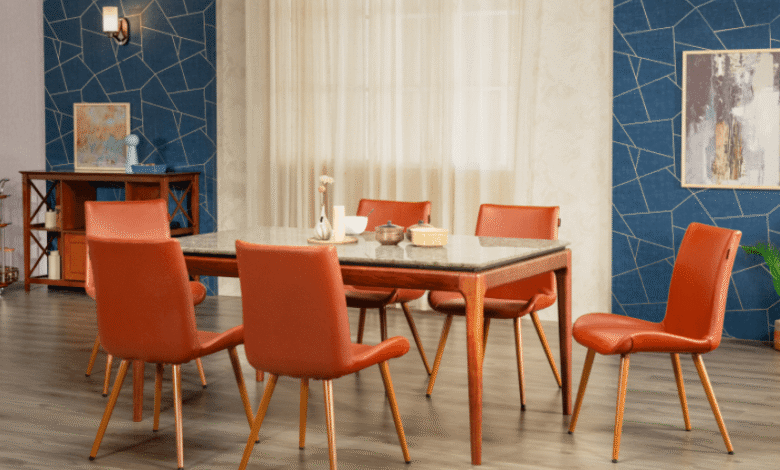
Dining tables have a habit of becoming far more than places to eat.
They collect homework, laptops, takeaway menus, birthday cakes, unopened mail and whatever someone couldn’t be bothered putting away properly. That means choosing one purely on appearance can backfire fairly quickly.
When you’re comparing dining room dining tables, it helps to think about how the table will function on an ordinary Tuesday, not just how it’ll look when the room is freshly styled.
Start With the Space Around It
The table itself is only part of the footprint.
You also need enough room for chairs to pull out comfortably and for people to move around them without squeezing sideways against a wall or cabinet.
A table that technically fits can still make a room feel cramped if circulation becomes awkward.
Before buying, measure the full dining area and mark out the proposed table dimensions on the floor with masking tape. It’s a simple trick, but it gives you a much better sense of scale than trying to imagine measurements from a product page.
Shape Can Change How the Room Feels
Rectangular tables are popular because they suit many dining rooms and accommodate larger groups easily.
Round tables, however, can work beautifully in smaller or more open spaces. With no corners to navigate, they can make movement easier and encourage a more conversational feel.
Oval tables sit somewhere in between, offering the capacity of a longer table with softer edges.
The right shape often depends less on what’s fashionable and more on the room you’re working with.
Think About Your Real Guest List
It’s tempting to buy for the biggest dinner party you might ever host.
That can leave you living with an oversized table 360 days of the year.
Instead, base the decision on how many people use it regularly, then consider whether an extendable design could handle occasional extras. If your household is two or four people most of the time, there’s little benefit in sacrificing half the room for permanent seating for ten.
Flexible furniture often makes more sense than furniture sized around rare occasions.
Materials Need to Match Your Tolerance Level
Some people happily accept scratches, marks and patina as part of a table’s character.
Others notice every ring left by a coffee mug.
Know which camp you’re in.
Timber can age beautifully, but different finishes require different levels of care. Glass can visually open up a room, though fingerprints may become part of your daily scenery. Stone and ceramic surfaces can offer durability, but they also bring weight and a very different aesthetic.
There’s no universally superior option. There’s only the one you’ll be happy maintaining.
See also: Specialized Home Care for Veterans by Mercy Home Services
Choose a Table That Can Handle Real Life
The best dining table usually isn’t the most dramatic one in the showroom.
It’s the one that comfortably fits the room, works with the number of people who actually use it and can survive the way your household lives.
Because once it arrives, it probably won’t just host dinner.
It’ll become a desk, meeting place, wrapping station, coffee spot and occasional storage surface too — and that’s exactly why it deserves a little more thought than simply picking the nicest tabletop.