Few materials manage to combine extreme heat resistance, electrical conductivity, and chemical stability quite the way graphite does, which is exactly why it has become such an indispensable material across metallurgy, semiconductor production, chemical processing, and countless other high-temperature industrial applications. Behind every graphite crucible, rod, or rotor sitting on a factory floor lies a genuinely fascinating transformation process, one that takes ordinary carbon-based raw materials and turns them into a precision-engineered industrial component capable of withstanding temperatures that would destroy most other materials outright. Understanding how graphite manufacturing actually works helps explain why this material commands such trust across so many demanding industrial applications.
What Makes Graphite Such a Unique Material
At the molecular level, graphite’s remarkable properties come from its distinctive layered carbon structure, where carbon atoms are arranged in stable hexagonal sheets. Within each layer, the carbon-to-carbon bonds are extraordinarily strong, giving graphite its structural integrity and resistance to thermal degradation. Between these layers, however, the bonding is much weaker, allowing the layers to slide relatively easily against one another. This dual structure is what gives graphite its somewhat unusual combination of properties: it is simultaneously strong enough to hold precise machined shapes under extreme heat, yet has enough internal lubricity to resist friction wear in moving industrial applications.
This same layered structure also explains graphite’s excellent electrical and thermal conductivity. Free electrons move relatively easily within and between the carbon layers, allowing graphite to conduct both heat and electricity far more efficiently than most non-metallic materials, which is precisely why it plays such a central role in applications like electrodes, heating elements, and high-temperature furnace components.
The Core Stages of Graphite Manufacturing
Producing high-quality industrial graphite components is a genuinely involved, multi-stage process, and understanding these stages helps explain both the material’s remarkable final properties and why quality control at each step matters so much to the finished product’s performance.
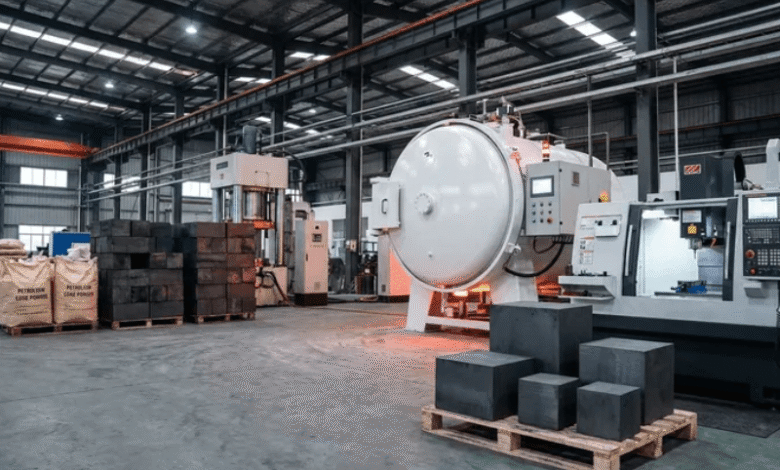
Raw material selection forms the foundation of the entire process. High-purity petroleum coke and coal tar pitch are the primary raw materials used in most industrial graphite manufacturing, and the quality of these starting materials directly influences the purity, strength, and performance characteristics of the finished graphite product. Manufacturers with strict sourcing standards for these raw materials generally produce more consistent, higher-performing final components.
Mixing and molding comes next, where the selected raw materials are combined, crushed to appropriate particle sizes, and then formed into the desired shape using either extrusion or vibration molding techniques, depending on the specific product being manufactured and its required density and structural characteristics.
Baking follows the initial molding stage, where the shaped “green” material is heated to carbonize the pitch binder holding the mixture together. This baking process gives the material its initial structural strength, though at this stage it remains amorphous carbon rather than true crystalline graphite.
Graphitization represents the most dramatic transformation in the entire manufacturing process. The baked components are subjected to extraordinarily high temperatures, often reaching up to 3000 degrees Celsius, inside specialized graphitization furnaces. This extreme heat treatment converts the amorphous carbon structure into the true crystalline graphite structure, dramatically improving the material’s purity, electrical and thermal conductivity, and overall heat resistance in the process.
Precision machining is the final stage, where the graphitized components are shaped using CNC machining to meet exact dimensional specifications required for their intended industrial application. This stage is particularly important for components like graphite rods, rotors, and molds that must fit precisely into larger industrial systems or perform specific mechanical functions.
| Manufacturing Stage | What Happens | Why It Matters |
| Raw material selection | High-purity coke and pitch sourced | Determines final purity and performance ceiling |
| Mixing and molding | Materials combined and shaped | Establishes density and initial structure |
| Baking | Carbonization of binder material | Provides initial structural strength |
| Graphitization | Heating up to 3000°C | Converts amorphous carbon to true graphite |
| Precision machining | CNC shaping to specification | Ensures exact fit for industrial application |
The Wide Range of Graphite Products
Modern graphite manufacturing produces a surprisingly diverse range of finished products, each engineered for specific industrial functions. Graphite rings, valued for their self-lubricating properties and excellent heat resistance, are commonly used in sealing and bearing applications where reducing friction under high-temperature conditions is essential. Graphite crucibles, built to withstand severe thermal shock and chemical erosion, serve as the vessels of choice for melting precious and non-ferrous metals across countless foundry and laboratory applications.
Graphite rotors play a particularly important role in molten aluminum treatment, where their high-quality construction enables exceptional degassing performance during the aluminum purification process. Graphite rods, available across a wide range of sizes and material grades, serve as fundamental raw materials for applications ranging from electric discharge machining electrodes to structural support components and heating elements. Graphite molds, precision-manufactured to achieve tight dimensional tolerances, support sintering, casting, and various other industrial forming processes where dimensional accuracy under extreme heat is non-negotiable.
Rounding out the product family, graphite plates provide high-strength structural components for furnace linings and heat sinks, graphite impellers handle the efficient mixing and pumping of corrosive industrial liquids, and graphite heating elements deliver even, reliable heat distribution inside vacuum and inert gas furnaces used across countless high-temperature manufacturing processes.
Material Properties That Define Quality
Not all graphite is created equal, and several measurable physical properties determine how well a given batch of material will perform in demanding industrial applications. Density is one of the most fundamental indicators, with higher-density graphite generally offering improved strength and durability under mechanical and thermal stress. Resistivity determines how effectively a graphite component conducts electricity, which is particularly critical for applications like electrodes and heating elements where consistent electrical performance is essential.
Flexural and compressive strength indicate how well a component will hold up under mechanical loading without cracking or deforming, an important consideration for structural applications like furnace linings or heavy-duty rods. Ash content, meanwhile, serves as a purity indicator; lower ash content generally correlates with higher-purity graphite, which typically translates into better overall performance and longer service life in demanding applications. Maximum working temperature, often reaching up to 3000 degrees Celsius in non-oxidizing atmospheres, defines the practical upper limit of where a given graphite product can be reliably deployed.
Why Consistency in Graphite Manufacturing Matters
Because graphite components are so often deployed in extreme, unforgiving industrial conditions- molten metal, high-vacuum furnaces, corrosive chemical environments- consistency across production batches becomes critically important. A manufacturer with rigorous quality control at every stage of graphite manufacturing, from raw material sourcing through final machining, produces components that behave predictably batch after batch, which matters enormously for industrial buyers who need to trust that a replacement component will perform identically to the one it is replacing.
This consistency requirement is precisely why working with an established, quality-focused graphite manufacturing partner tends to deliver better long-term outcomes than sourcing from suppliers with less rigorous or less transparent production standards. Buyers evaluating potential suppliers should look for manufacturers who can provide detailed material test reports and consistent documented specifications for properties like density, resistivity, and strength, since this transparency is a strong indicator of disciplined, quality-controlled graphite manufacturing practices.
Customization Within a Standardized Process
One of the notable strengths of modern graphite manufacturing is the ability to combine a highly standardized, quality-controlled production process with genuine customization for specific customer requirements. Dimensions, shapes, and material grades can all be tailored to a buyer’s exact specifications, whether that means a custom-machined stirring rod for a specialized chemical process or a precisely dimensioned crucible built to fit a particular furnace configuration. This flexibility, combined with the underlying consistency of a well-controlled manufacturing process, is what allows graphite manufacturers to serve such a genuinely diverse range of industries from a shared core production expertise.
Choosing a Manufacturing Partner You Can Rely On
For buyers sourcing graphite components for critical industrial applications, understanding this full manufacturing journey, from raw carbon through graphitization to precision machining , provides valuable context for evaluating potential suppliers. A specialist in graphite manufacturing that maintains tight control over every stage of this process, backed by documented material specifications and genuine customization capability, is generally far better positioned to deliver the consistent, reliable components that demanding industrial applications require. Reviewing a full graphite manufacturing product catalog before committing to a supplier makes it much easier to compare available grades, standard dimensions, and customization options across the full range of graphite components a given operation might need.