If you’re sourcing power conversion equipment for a mid-sized commercial building, an industrial facility, or a multi-unit property, you’ve likely landed on the 50kW inverter as your target capacity. It’s the sweet spot where single large commercial installations sit before projects move into multi-megawatt utility territory.
This guide helps facility managers, EPC contractors, and procurement teams understand what a 50kW inverter actually does, how it differs from smaller residential units, and what to check before selecting one, so you don’t end up with equipment mismatched to your site’s real electrical demand.
What Counts as a 50kW Inverter
A 50kW inverter converts DC power, whether from solar arrays, battery banks, or both, into AC power at a continuous output rating around 50 kilowatts. At this size, inverters are almost always three-phase, since single-phase equipment struggles to handle that much continuous load efficiently, and most commercial electrical services are three-phase to begin with.
50kW sits at an important threshold. It’s large enough to serve a small-to-mid commercial building, a warehouse, a school, or a light industrial site, but still small enough to install as a single unit rather than requiring a multi-inverter skid or containerized system. Many manufacturers offer 50kW as a standard SKU precisely because it maps so well onto common commercial load profiles.
String, Central, and Hybrid 50kW Inverters
Not all 50kW inverters serve the same function. Three configurations dominate the market today.
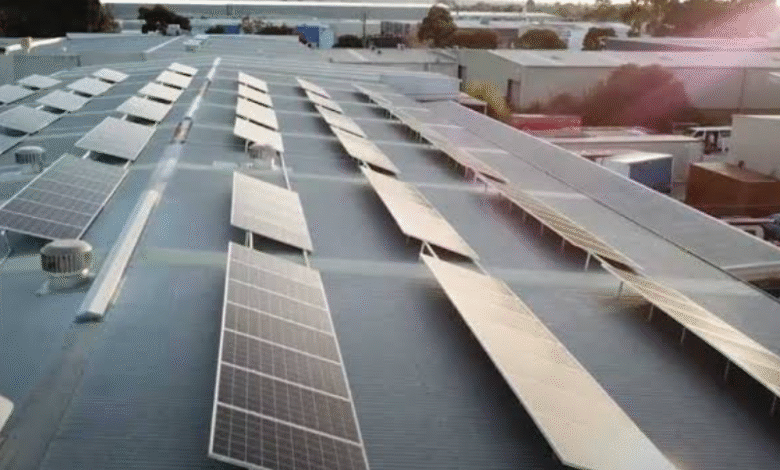
String inverters at 50kW are increasingly common as string inverter technology has scaled up from residential sizes. They offer a modular design, meaning several units can be deployed across a roof or ground array, with each string inverter maximizing power point tracking for its own section of panels.
Central inverters at 50kW consolidate fewer, larger conversion points into a single unit. This configuration is more common in older commercial installs and tends to be more difficult to service without impacting the entire array.
Hybrid 50kW inverters combine solar input with battery storage integration, allowing the same unit to manage grid-tied solar generation and dispatch stored battery power for peak shaving or demand charge management, all from a single piece of equipment.
Where 50kW Inverters Are Typically Deployed
| Application | Typical Load Profile | Why 50kW Fits |
| Mid-size commercial rooftop solar | 150–300 kW peak demand array split across units | Modular, allows redundancy if one unit fails |
| Warehouse or light industrial | 200–400A three-phase service | Matches common electrical service sizing |
| Multi-unit residential/apartment complex | Shared building loads + common area power | Serves shared systems without oversizing |
| C&I battery storage (peak shaving) | Demand charge reduction target | Standard hybrid inverter capacity tier |
| Agricultural / irrigation operations | Pump and equipment loads | Handles motor start surges reliably |
Key Specifications to Check Before Buying
When evaluating a 50kW inverter, procurement teams should look well beyond the headline power rating printed on the spec sheet.
Maximum DC input voltage and MPPT range determine how many panels or battery strings can connect and how much flexibility exists in the overall array design.
Efficiency rating, whether measured as CEC or European weighted efficiency, matters more than most buyers assume, since even a 1–2% efficiency gap compounds significantly over a 15 to 25 year system life.
Three-phase output configuration needs to be confirmed directly against your site’s utility service, since voltage requirements typically fall at 208V, 480V, or a configurable range depending on the installation.
Ingress protection rating determines suitability for the installation environment. Outdoor-rated units need IP65 or higher, while indoor installs can use lower-rated, often less expensive equipment.
Parallel and stacking support matters for sites needing more than 50kW. Confirm the manufacturer supports stacking multiple units under one unified monitoring platform, rather than treating each unit as an isolated system that has to be managed separately.
Certifications should meet UL 1741 and IEEE 1547 for grid interconnection in the US, or IEC 62109 for projects outside the US.
Sizing: Matching the Inverter to the Array and Load
A common mistake is selecting a 50kW inverter based on array size alone, without checking the site’s actual demand first. Best practice is to size the inverter close to the site’s realistic peak load, then oversize the DC array modestly, with a DC-to-AC ratio of roughly 1.1 to 1.3 being typical, to account for panel degradation and non-optimal operating conditions. Oversizing the inverter itself beyond actual site demand adds cost without adding usable output, since the inverter simply clips any excess DC power above its rated AC output rather than converting it into usable energy.
How the System Fits Together
It’s worth picturing the full path energy takes through a 50kW inverter installation rather than viewing the inverter as an isolated piece of equipment. DC input arrives from the solar array and, in hybrid configurations, from a battery bank as well. The inverter converts that DC power into three-phase AC output, which feeds into the facility’s distribution panel alongside the utility grid connection. A monitoring or energy management platform typically sits on top of this setup, giving facility managers or installers visibility into performance and allowing remote diagnostics without a site visit. Because the inverter is the single conversion point for all of this energy, its reliability has an outsized impact on the performance of the entire installation.
Why Independent Performance Testing Matters
Because inverter manufacturers naturally highlight their own products’ strongest numbers, it’s worth checking a unit’s claimed specifications against independent inverter reliability testing rather than relying solely on marketing materials. Independent inverter reliability testing evaluates real-world efficiency curves, thermal performance under sustained load, and failure rates across large sample sizes, offering a far more complete picture than a manufacturer’s peak efficiency claim alone. Comparing a shortlisted inverter’s specifications against independent inverter reliability testing before finalizing a purchase can help procurement teams avoid selecting a unit that looks strong on paper but underperforms once it’s actually installed and running under real site conditions.
See also: Building Opportunity and Prosperity Through Business in Andorra
Final Thoughts
Choosing the right 50kW inverter comes down to matching the equipment to your site’s actual peak demand, not just its array size, and verifying key specifications like efficiency, three-phase configuration, and certification status before committing to a purchase. String, central, and hybrid configurations each serve different project needs, and understanding which one fits your site will save both money and headaches down the line. Taking the time to check independent performance data alongside manufacturer specifications is one of the simplest ways to make sure a 50kW inverter performs as expected for the full 15 to 20 years it’s designed to last.