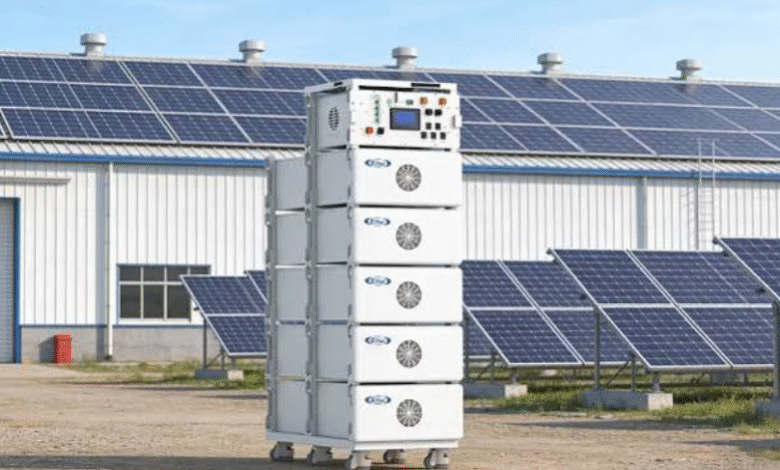
Commercial and industrial electricity bills aren’t driven by usage alone. A huge share comes from demand charges, the fee utilities apply based on the single highest spike in power draw during a billing cycle. Understanding how storage interacts with that fee structure is what separates a project that delivers real bill savings from one that simply buys capacity the site never actually needs. Getting this right is exactly why C&I energy storage has become such a central part of commercial energy planning.
This guide helps facility managers, energy consultants, and business owners understand what C&I energy storage actually does, how it’s sized and financed differently from residential systems, and what to evaluate before committing to a project.
What Is C&I Energy Storage
C&I energy storage refers to battery systems deployed at commercial and industrial sites, office buildings, manufacturing plants, warehouses, data centers, retail chains, and similar facilities, to manage how and when electricity is drawn from the grid. Unlike residential energy storage, which is mostly about backup power and self-consumption of rooftop solar, C&I storage is primarily a financial tool. It’s deployed to reduce demand charges, shift usage away from expensive peak-rate periods, and in some markets, even earn revenue by participating in grid services.
Systems typically range from 30kW to several megawatts, use lithium iron phosphate battery chemistry for its safety and cycle life advantages, and are paired with software that automates charge and discharge decisions based on the site’s actual load pattern and utility rate structure. This is the core distinction that sets C&I energy storage apart from smaller residential setups.
Why Businesses Deploy C&I Energy Storage
There are four main financial drivers behind most C&I storage projects, and many projects combine more than one at once.
Demand charge management involves discharging the battery during the site’s highest-draw periods to shave the peak that determines the demand charge line item on a utility bill.
Time-of-use arbitrage means charging the battery when electricity is cheap during off-peak hours and discharging it when rates are at their highest.
Backup power and resiliency keep critical operations running during outages, which matters especially for facilities with sensitive equipment or continuous processes that can’t tolerate downtime.
Grid services and incentive programs allow some regions to let C&I storage participate in demand response programs or capacity markets, creating an additional revenue stream on top of direct bill savings. When these drivers are combined effectively, C&I energy storage can pay for itself well before the equipment reaches end of life.
Comparing C&I Storage Drivers by Facility Type
| Facility Type | Primary Driver | Typical System Size | Secondary Benefit |
| Manufacturing plant | Demand charge management | 200kW–2MW | Backup for critical process lines |
| Office building / commercial real estate | TOU arbitrage + demand charges | 50–500kW | Resiliency for tenants |
| Data center | Backup power/resiliency | 500kW–5MW+ | Grid services participation |
| Retail chain (multi-site) | Demand charge management | 30–150 kW per site | Solar self-consumption |
| Cold storage/refrigeration | Demand charge + backup | 100kW–1MW | Protects perishable inventory during outages |
| Agricultural / irrigation | TOU arbitrage | 50–300kW | Handles pump motor start surges |
How C&I Energy Storage Systems Are Sized
Sizing a C&I system correctly requires actual interval load data, not just a facility’s monthly bill total, and skipping this step is one of the most common reasons projects underperform expectations.
The process starts by pulling 12 months of 15-minute interval load data from the utility or building meter to identify peak demand patterns and how consistently they actually occur throughout the year. From there, the demand charge savings potential gets modeled, since a battery only saves money if it can reliably predict and shave the specific peaks the utility bills against. The inverter then needs to be sized to the facility’s peak simultaneous load, not the average, which is why C&I sites often require 50kW, 100kW, or larger inverter capacity, frequently in three-phase configuration. Battery capacity in kWh should be sized to cover the duration of typical peak events, commonly two to four hours for demand charge management use cases. Finally, if solar is present on-site, it needs to be layered into the analysis to determine whether the storage system should also handle self-consumption optimization alongside peak shaving. Skipping this data-driven approach is the single biggest reason a C&I energy storage project fails to hit its projected payback.
Financing and Ownership Models
Most C&I energy storage projects use one of three ownership structures, each with a different risk and cost profile.
Direct purchase means the business owns the system outright and captures 100% of the savings, typically with a four to eight year payback depending on local rate structures and incentives available.
Power purchase agreements, or storage-as-a-service arrangements, involve a third party owning and maintaining the system, while the business pays for the service or a share of savings with little to no upfront cost.
Lease financing works similarly to a PPA but is structured as a fixed lease payment rather than a savings-share arrangement, which can make budgeting more predictable for some organizations.
How the System Comes Together on Site
It helps to picture the full flow of energy through a C&I storage installation rather than thinking of the battery as a standalone box. The utility grid and, if present, on-site solar both feed into the battery inverter, which manages charging of the lithium-ion battery bank based on real-time conditions. Energy management software continuously monitors utility rate structures and demand data, deciding when to charge, when to discharge, and how aggressively to shave a developing demand peak. That decision-making layer is ultimately what determines whether a system delivers its projected savings, which is why software quality deserves just as much scrutiny during procurement as the battery hardware itself.
Why Independent Cost and Performance Benchmarks Matter
Because C&I storage economics depend heavily on assumptions about battery degradation, demand charge savings, and financing terms, it’s worth grounding your project evaluation in independent storage cost benchmarking rather than relying solely on a vendor’s own savings projections. Independent storage cost benchmarking tracks real installed costs, actual performance data, and financing terms across many completed projects, giving a far more realistic picture than a single proposal’s optimistic modeling. Comparing a vendor’s projected payback period against independent storage cost benchmarking for similar facility types and system sizes is one of the most reliable ways to sanity-check a proposal before signing a contract, particularly for larger projects where an overly optimistic savings estimate becomes an expensive mistake. Benchmarking against real project data is especially important before scaling any C&I energy storage investment across multiple sites.
See also: Transforming Brand Narratives into Business Assets
Final Thoughts
C&I energy storage can deliver meaningful bill savings, but only when it’s sized against real interval load data, matched to the right combination of demand charge management, time-of-use arbitrage, and resiliency goals, and financed under a structure that fits your organization’s risk tolerance. Facilities that skip the interval data analysis or rely purely on vendor projections tend to end up with systems that underdeliver relative to their cost. Taking the time to verify sizing assumptions and benchmark projected savings against independent data will consistently lead to a storage investment that actually pays off.